Our Research
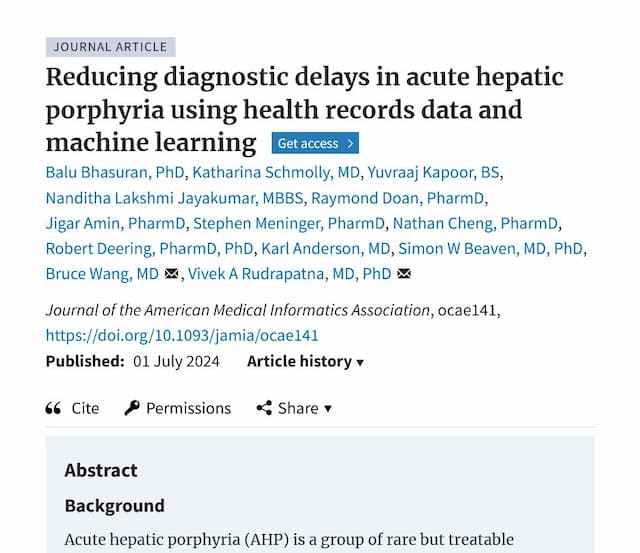
Reducing diagnostic delays in acute hepatic porphyria using health records data and machine learning
Acute hepatic porphyria (AHP) is a group of rare but treatable conditions associated with diagnostic delays of 15 years on average. The advent of electronic health records (EHR) data and machine learning (ML) may improve the timely recognition of rare diseases like AHP. However, prediction models can be difficult to train given the limited case numbers, unstructured EHR data, and selection biases intrinsic to healthcare delivery. We sought to train and characterize models for identifying patients with AHP.
Read More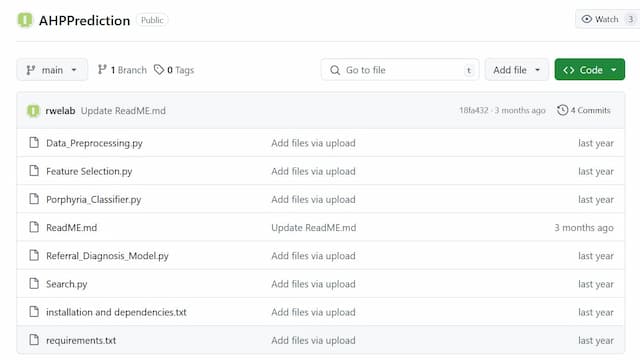
AHP Prediction
Using electronic health records (EHR) data from two centers we developed models to predict: 1) who will be referred for AHP testing, and 2) who will test positive. The best models achieved 89-93% accuracy on the test set. These models appeared capable of recognizing 71% of the cases earlier than their true diagnosis date, reducing diagnostic delays by an average of 1.2 years.
Read More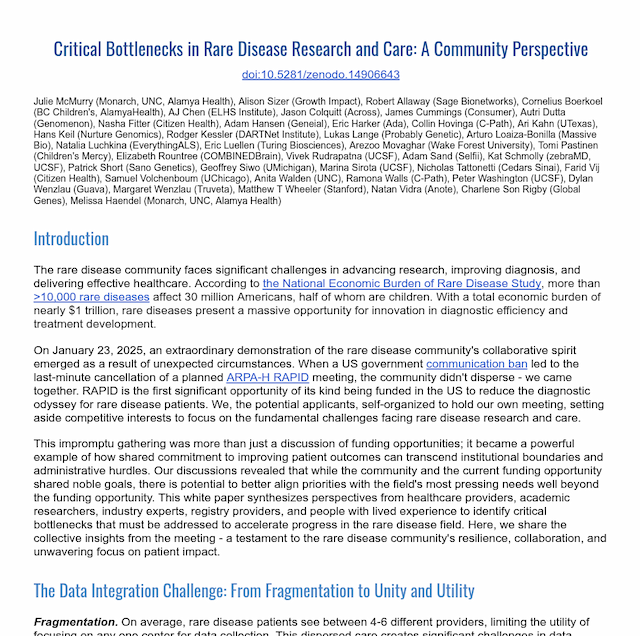
Critical Bottlenecks in Rare Disease Research and Care: A Community Perspective
This document details an impromptu community gathering following the cancelation of an ARPA-H proposer's day for the Rare Disease AI/ML for Precision Integrated Diagnostics (RAPID) program. The discussion became a powerful example of how shared commitment to improving patient outcomes can transcend institutional boundaries and administrative hurdles. This white paper synthesizes perspectives from healthcare providers, academic researchers, industry experts, registry providers, and people with lived experience to identify critical bottlenecks that must be addressed to accelerate progress in the rare disease field.
Read MoreLooking for Collaborators
Have you or someone you know made a predictive algorithm for rare disease but have not been able to clinically implement it? Wondering how to train your EPIC EHR algorithm on other EHR systems' data?
We can help with integration and use in clinical practice.
Our goal is to offer a platform full of rare disease algorithms that can improve lives, directly at the point of care. Our service will always be free for patients and providers alike.
All of our algorithms are open source IP and we do not enter into licensing deals.